
July 30, 2026
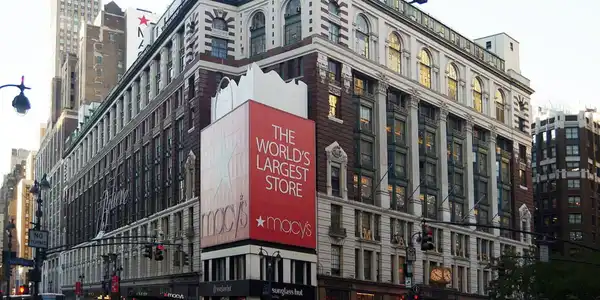
One of New York City’s most recognizable retail landmarks changed dramatically over the weekend. The giant shopping bag billboard that has wrapped the corner of Macy’s Herald Square at 34th Street and Broadway for 60 years was taken down, temporarily uncovering a five-story structure that has been hidden behind signage since the 1920s. The building, known as the Million Dollar Corner, carries a rivalry-fueled backstory that stretches back to the earliest days of the Herald Square retail corridor.
Quick Answer: Macy’s removed its 60-year-old shopping bag sign from the corner of 34th Street and Broadway in late July 2026. The takedown revealed a historic five-story building at 1313 Broadway known as the Million Dollar Corner, which has been obscured by billboard space leased by Macy’s since the 1920s. A new, modernized sign is expected to replace the old one, though the exact design has not been announced.
What Happened
Workers removed the red-and-white shopping bag sign over the weekend of July 26–27, 2026, according to reporting by 6sqft. The billboard, which proclaimed Macy’s as “The World’s Largest Store,” had occupied the facade through several iterations over six decades. Roughly 240,000 pedestrians pass that corner every day, and for at least a short window, they are getting a look at the building behind it for the first time in living memory.
Macy’s confirmed the removal in a statement to the New York Post, saying the sign is “outdated” and will be removed as part of updates by the billboard owner to modernize the space. No timeline or design for a replacement has been announced publicly.
The Story Behind the Building
The five-story structure at 1313 Broadway is one of the city’s most famous real estate holdouts. When Macy’s relocated from 14th Street to Herald Square in 1900 and began assembling land to build what the New York Times described at the time as a “mammoth store,” a competitor got in the way.
Henry Siegel of Siegel-Cooper, a rival department store, reportedly purchased the corner plot after Macy’s had reached only a verbal agreement to acquire it. Siegel is said to have held the parcel as leverage, aiming to force Macy’s to sell him its 14th Street location. Macy’s refused, and instead built the department store around the holdout structure. Siegel later demolished the original building and erected the current five-story structure in its place.
In 1911, the property at 1313 Broadway sold for $1 million, a record price at the time, which gave rise to its enduring nickname: the Million Dollar Corner. Macy’s has leased billboard space on its facade since at least the 1920s, including the four-story shopping bag sign that came down last week.
Who Owns the Billboard, and Why It Matters
The building and its billboard rights are owned by Kaufman Realty, not Macy’s. That distinction became legally significant in 2021, when Macy’s sued Kaufman after reports emerged that the real estate firm might allow Amazon to advertise on the corner. Macy’s argued that lease terms dating to 1963 prohibit Kaufman from renting billboard space to a direct competitor. The lawsuit kept the shopping bag in place for another five years.
By June 2026, Kaufman told the Post that the two parties were still “in discussions” about the future of the corner sign. The city’s Department of Buildings issued a removal permit on June 12, 2026, and the sign came down shortly afterward.
What Comes Next
Macy’s described the removal as part of “broader updates” by Kaufman to modernize the space, though neither party has specified what form any new signage will take. The temporary absence of the billboard gives the public an unusually clear view of the Beaux-Arts building that has sat, largely unseen, at one of Midtown’s busiest intersections for over a century.
The wider Herald Square corridor has seen substantial investment in recent years. Vornado Realty Trust announced plans in late 2025 for a 475-unit rental tower at West 34th Street and Eighth Avenue, roughly half a block away, part of a broader push to redevelop the blocks around Penn Station. The Macy’s sign change adds another visual marker to what is quietly becoming a transitional moment for the neighborhood.
Why This Matters for NYC Real Estate
For those of us watching the Manhattan market closely, the Macy’s sign story is a vivid reminder of how the physical character of a corridor shapes buyer and tenant perception. Herald Square has long been defined by its retail density, but the area directly south of Midtown is evolving. Vornado’s planned residential tower, ongoing Penn Station improvements, and now a high-visibility change at one of Midtown’s most trafficked corners all point in the same direction: this stretch of the city is being repositioned. Changes at this scale tend to ripple outward into neighboring residential markets, and we will be watching closely.
This story is based on reporting by Devin Gannon for 6sqft, published July 28, 2026.
Frequently Asked Questions
Why was the Macy’s Herald Square shopping bag sign removed?
Macy’s said the sign is outdated and is being taken down as part of broader modernization efforts by Kaufman Realty, which owns the building and billboard rights at 1313 Broadway. A replacement sign is expected but has not been designed or announced publicly.
What is the Million Dollar Corner building?
The Million Dollar Corner is a five-story commercial building at 1313 Broadway at the corner of 34th Street, embedded within the larger Macy’s Herald Square block. It earned its nickname when it sold for a then-record $1 million in 1911, the result of a 19th-century real estate rivalry between Macy’s and competitor Henry Siegel of Siegel-Cooper.
Who owns the building at the corner of 34th Street and Broadway?
Kaufman Realty owns 1313 Broadway, including its billboard space. Macy’s leases the retail block around it but does not own the corner parcel. This ownership split led to a 2021 lawsuit in which Macy’s argued that 1963 lease terms bar Kaufman from renting billboard space to competing retailers.
How long was the Macy’s shopping bag sign up?
The billboard has occupied the corner facade for approximately 60 years, with the current red-and-white shopping bag version being the most recent iteration. Macy’s has leased billboard space on the building since at least the 1920s.
How does the Macy’s sign removal affect the surrounding real estate market?
The immediate impact is aesthetic and symbolic rather than transactional. However, the change is part of a broader pattern of reinvestment in Herald Square and the blocks around Penn Station, including Vornado’s planned 475-unit residential tower nearby. Neighborhood repositioning at this scale tends to affect retail rents, foot traffic patterns, and eventually residential demand in adjacent areas.
Social Cookies
Social Cookies are used to enable you to share pages and content you find interesting throughout the website through third-party social networking or other websites (including, potentially for advertising purposes related to social networking).